Lorenzo Villalobos
Full-Stack Developer & Project Rockstar
I build systems that work. Whether I'm writing TypeScript, Go, or PHP, the language is just a tool. My focus is the architecture: fast, maintainable, and honest about its complexity. I architect, containerize, and deploy on infrastructure I own and maintain.
- Self-Hosted Everything
- Full-Stack • DevOps • Cloud
- Costa Rica • Global Clients
About
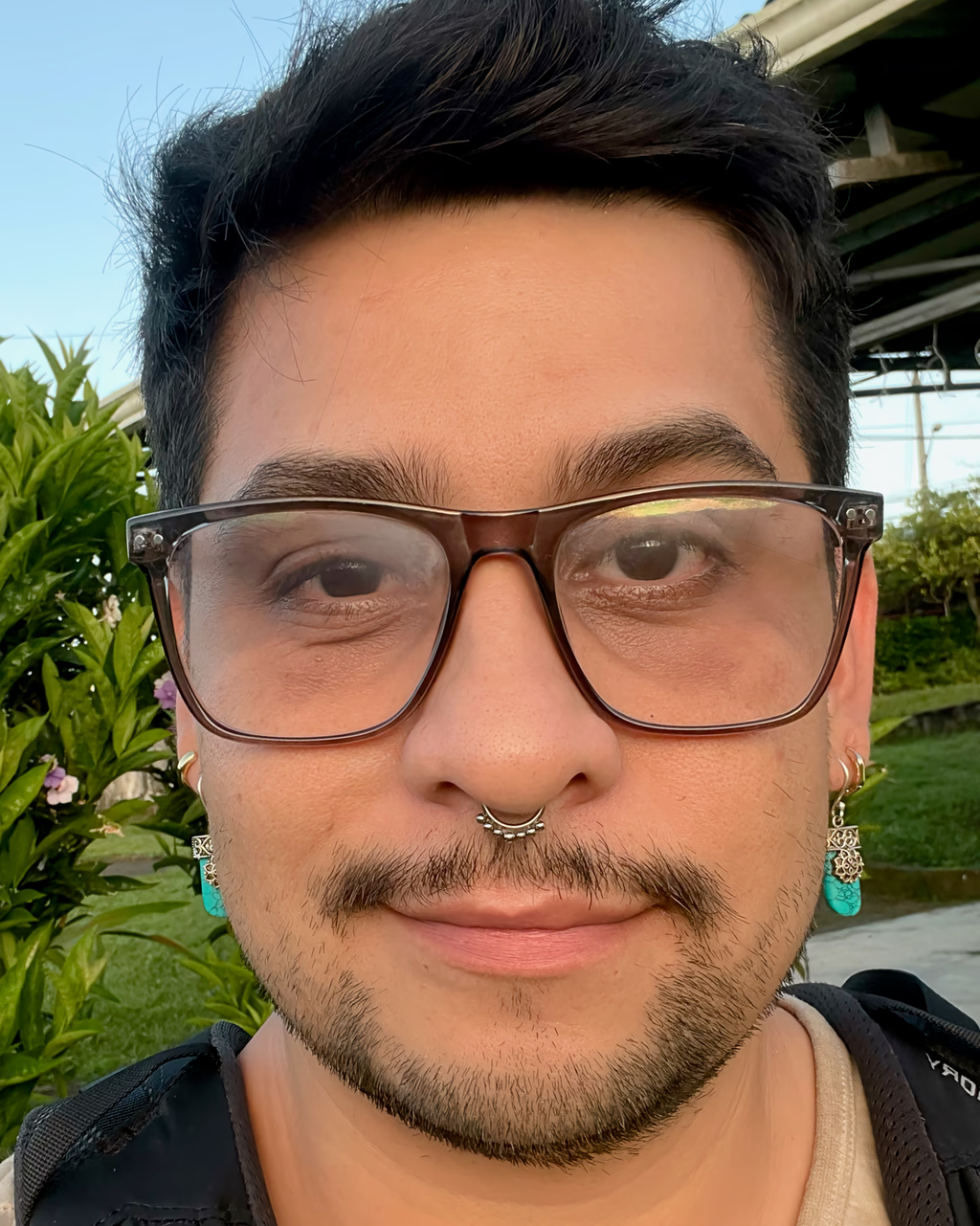
I'm Lorenzo Villalobos, and I build systems that work. While the industry chases shiny frameworks or abstracted cloud services, I've built my career on absolute ownership of the stack. Whether I'm writing TypeScript, Go, or PHP, the language is just a tool. My focus is the architecture: fast, maintainable, and honest about its complexity. I don't just write code. I architect, containerize, and deploy on infrastructure I own and maintain.
I founded Vector Costa Rica in 2018 for this level of engineering rigor. I'm not interested in shipping "good enough" code and hiding behind third-party dependencies. I prefer to build the hard parts: self-hosted Git servers, real-time terminal dashboards, CDN asset pipelines, and multi-tenant SaaS platforms. I handle everything from the database schema to the production deployment pipeline.
My philosophy is driven by the need to resolve. I don't have a favorite stack; I have a toolbelt. I pride myself on being the person who can look at a messy business problem and identify the exact architecture to solve it properly. This isn't about following a ticket or checking off a feature list. It's about the craft of building digital infrastructure that creates lasting value for the people who actually use it.
Skills & Expertise
Full-stack development, self-hosted infrastructure, and API-driven systems, from first commit to production deployment.
Tooling Expertise
What I've been building
A live look at my work across the Vector codebase. Real commits, pulled straight from GitHub.
Commits per month
What I build in
Updated Jun 26, 2026
Projects & products
What I have built and why. Open any card for the approach behind it.
Vela
I built Vela to stop depending on third-party UI frameworks and keep one consistent visual language across everything I ship. The core decision was to describe each component once in a custom Component Description Language (CDL) and generate real implementations for four targets, Astro, React, Laravel Blade, and vanilla JS, instead of maintaining four hand-written copies that drift apart. My CLI scaffolds every component with correct OKLCH token usage, three-tier placement, and TypeScript interfaces, so the spec stays the source of truth.
The Studio is where I tune the system: a real-time theme editor with WCAG contrast gating that checks accessibility as you edit, 1,900+ Google Fonts with 16 curated pairings, 15 icon libraries (~70k icons), and an animation playground. Themes are versioned with full audit trails and export to CSS @theme, JSON, W3C Design Tokens, and Style Dictionary, so the work stays portable.
It ships as scoped packages on a self-hosted npm registry, so distribution stays under my control.
Orion
I built Orion to replace a dozen disconnected SaaS subscriptions with one platform I own end to end. It is an Astro SSR and React hybrid I architected, with 29 server-rendered pages and 120+ API endpoints covering clients, leads, projects, invoices, email, calendar, repository browsing, deployment monitoring, and task analytics.
My guiding decision was to integrate deeply rather than bolt tools together: Google OAuth for auth, Drive for documents, Gmail to compose and send, Calendar for scheduling, and Contacts for customer data, so everything lives in one place. Repository integration gives real-time browsing with commit history, branch management, and GPG support, while Coolify monitoring tracks deployment health across every project.
I also exposed 81 structured WebMCP tools across 17 pages so AI agents can operate the platform programmatically, which keeps Orion usable by both people and automation.
All Star Realty
I built a full property-management platform for an Alaskan real estate firm, well beyond the marketing site they came for. The starting point was a WordPress replacement, but the real need was operations, so I grew it into a purpose-built tool.
I integrated ShowMojo's API for automated showing coordination and lead routing, pulled Google Analytics and Search Console into a custom admin dashboard, and built interactive property maps with MapLibre GL, all backed by PostgreSQL. The back-office handles listings with geolocation, lead management with automated email notifications, and real-time analytics in Chart.js.
Choosing to build rather than configure paid off in fit: the firm got workflows shaped around how they actually work, documented across 70+ pages of technical reference.
CraftWorks CR
I built CraftWorks as a bilingual artisan marketplace so Costa Rican makers get a platform where their identity is not buried under algorithmic scale. My core decision was to treat bilingual support as structural, not cosmetic: it runs through database fields, emails, SEO metadata, and UI, never as a translation afterthought.
Artists get profiles with bios, social links across 8 platforms, and portfolios organized by 22 material types. Messaging is privacy-first, with anonymous buyer aliases and PII auto-redaction, and moderation runs through 16 report categories with graduated enforcement.
I shipped it in 11 working days across 447 commits: 8 data models, 22 API endpoints, a tiered free plan, and automated cron jobs for product auto-disable and account cleanup. It runs on Astro SSR with Prisma, scores 99/100 on mobile Lighthouse, and is backed by 83 unit tests and 63 Playwright E2E tests.
Flux
I designed Flux for the people mainstream budgeting apps ignore: gig workers, weekly earners, crisis-mode households. The insight that drove every decision is that apps like YNAB and Mint force monthly thinking, but most people do not experience money monthly. So I made Flux adapt to any cadence, daily through custom, and replaced generic categories with a four-tier mission system, Survival, Obligations, Growth, and Lifestyle, that turns budgeting into intentional prioritization.
The architecture backs that philosophy: multi-ledger support for separate financial contexts, multi-currency with real-time conversion, AES-256-GCM field-level encryption, Sankey diagrams for income distribution, and a Transfer Manifest that generates weekly target checklists with CSV export.
I added an Overwhelm Mode that collapses the interface to a single priority when the numbers feel like too much, with no judgment or shame language. Built on Astro SSR with Drizzle and 6-language i18n.
Vector Costa Rica
I built Vector's agency site as the public face of the whole ecosystem, so it had to showcase the portfolio and services while tying the internal tooling I made (Orion, Atlas, Vela) to client-facing work. It is bilingual on Astro 5 with React 19, Three.js for 3D visual elements, and Satori for dynamic OG image generation.
The blog runs on Astro Content Collections with full-text search, and I optimized content with sitemaps, hreflang tags, JSON-LD structured data, and OpenGraph metadata. Static assets serve from a CDN pipeline, and the whole thing deploys via Docker on Coolify from the production branch.
Norma
I built Norma as a headless Go service that bridges applications with Costa Rica's Ministerio de Hacienda electronic invoicing API. My design goal was to isolate the cryptographic risk in one place: Norma signs XML documents with XAdES-EPES signatures, submits them to Hacienda's OAuth2 endpoint, and queries document status, so calling applications never touch raw cryptography.
The signing follows ETSI TS 101 903 v1.3.2 in a 9-step flow, from loading PKCS#12 certificates to RSA-SHA256 signing, all in native Go with no external signing libraries or OpenSSL shell-outs. I kept it deliberately stateless, no database, no persisted credentials, no business logic, so certificates arrive per-request and are never stored.
Per-tenant rate limiting protects the shared IP from Hacienda's abuse detection, so any application that needs Costa Rican e-invoicing can share one Norma instance.
Vector Bookings
I built Vector Bookings as a multi-tenant hotel booking platform on Laravel 12 for the Costa Rican hospitality market. The defining decision was complete data isolation: each hotel gets its own database identified by subdomain, so a security incident or schema migration in one tenant never affects another.
It uses full RBAC via Spatie Permission and Google OAuth through Laravel Socialite, and handles room management, reservations, payment processing, vendor integrations, and calendar-based availability. The frontend runs Tailwind CSS 4 with Vite 7.
I have Norma integration planned next, so hotels can generate Hacienda-compliant tax documents straight from completed bookings with no manual work.
Rigel
I built Rigel as a real-time terminal dashboard for Atlas, my task tracker, so I never have to leave the terminal to see task status. It uses React and Ink for terminal rendering and compiles to a standalone binary that runs anywhere with no Node.js runtime.
Five keyboard-switchable views (Kanban, Rows, Tree, Sprint Focus, Statistics) give instant visibility. The key design choice is Global Mode: Rigel scans every project directory for task databases, aggregates across all repos, and presents one unified dashboard with per-repo filtering. It detects git remotes, tracks git state, and watches files so the display updates the moment a task changes.
It syncs upstream through a fingerprint-based dedup system that only pushes real changes, and the sync is non-blocking, so an unreachable server never affects local state.
Forgejo Git Server
I stood up a self-hosted Forgejo instance as the single source of truth for source code across 12+ repositories. Self-hosting was a deliberate choice: complete control over access, uptime, and data residency, with no vendor lock-in.
Forgejo is a lightweight Git forge on Docker, and I configured it for repository hosting, issue tracking with scoped labels, an npm package registry for scoped packages, release management, and webhook-driven deployments. It handles GPG-signed commits, protected branches, and organization-level label sets that enforce consistent issue classification across every repo.
I wired webhook integrations with Coolify so a push to production builds the Docker image and ships the new container live, with no external CI/CD.
Atlas
I built Atlas as a task and project tracking system where every piece of work was traceable to a commit and nothing lived in a disconnected external tool. It started as a fork of Beads, a distributed, git-backed task tracker in Go: each project stored its tasks in a directory alongside the code, synced through git like any other file.
The methodology was the point. Tasks were the source of truth, labels carried priority, kind, and status, and I tied the pipeline together so every commit synced to its task as a note, creating a real-time development log anyone could read without asking for a status update. My fork added Forgejo issue syncing, a Dolt-backed database for SQL queries, and a build system that compiled credentials into the binary.
I later retired Atlas as I consolidated tracking onto GitHub Projects, carrying the same discipline forward: issues as source of truth, labels for priority/kind/status, everything traceable to a commit.
Lyra
I built Lyra as a self-hosted CDN asset manager to own asset delivery end to end and avoid per-transform fees and vendor lock-in. The approach was upload-once: a Sharp-based pipeline generated 6 responsive WebP variants per upload, stored them on object storage, and returned framework-ready snippets with srcset, sizes, and lazy loading.
Every image got blur placeholders via blurhash, dominant-color extraction, and SHA-256 deduplication, and on-the-fly URL transforms handled ad-hoc resizing with an in-memory LRU cache. I shipped React and PHP/Laravel SDKs, exposed 8 WebMCP tools for AI agents, and backed it up incrementally with ETag-based diffing.
At its peak it served optimized assets across 10+ projects. I have since decommissioned it in favor of SeaweedFS, which now handles object storage and CDN duties.
Americas Worldwide
I migrated Americas Worldwide off a WordPress site that could not handle their business logic and onto a Laravel 11 application. The driving reason was that their workflows, wholesale investment accounts, order processing, and transactional email, are multi-step business logic that WordPress plugins cannot express cleanly.
The new platform adds PayPal payment processing, role-based access control, and a proper admin dashboard. I preserved their existing content and SEO equity through the migration while giving them a backend that can grow with the business, deployed via Coolify with Vite and Tailwind for a responsive design that works across their international client base.
Ecos Costa Rica
I built a portfolio-driven website for a Costa Rican construction and architecture firm, with 17 project gallery pages and 440+ optimized images. My central challenge was keeping the experience fast despite hundreds of high-resolution photos, so images serve as responsive AVIF variants with blurhash placeholders and dominant-color extraction, and a CdnImage component I wrote generates srcset across 6 breakpoints automatically.
Every image loads progressively: blur placeholder first, then dominant color, then the full responsive image. I used GSAP for scroll-triggered animations, Swiper for the homepage hero, and PhotoSwipe for full-screen gallery browsing, with contact forms protected by reCAPTCHA v3.
Savingface Skin Care
I delivered a complete digital rollout for a new skincare business, not just a website but the whole digital infrastructure. The goal was to launch the business, so I handled the branding design, set up Google Workspace for business email, and built a custom Astro site with a booking form that fits into the owner's daily workflow.
The site is built for conversion, with clear service descriptions, before/after galleries, and a booking flow that reduces friction to a single submission, plus SEO from sitemap generation, structured metadata, and Astro's fast static rendering.
The Chorotega
I redesigned The Chorotega's web presence from scratch with Astro and GSAP, using scroll-driven animations to guide visitors through the brand story. I followed an atomic design system where base components compose into sections, so every page feels cohesive while staying maintainable.
I treated performance as a constraint alongside the visuals: GSAP animations are GPU-accelerated and only trigger on scroll intersection, images are optimized at build time, and the site scores in the high 90s on Lighthouse, with sitemap generation, OpenGraph metadata, and semantic HTML throughout.
Level up Handyman
I built a website for a handyman service with a distinctive 90s video-game aesthetic that makes it memorable in a sea of generic contractor sites. The creative direction was a deliberate bet: this audience responds to personality, and the retro look builds trust through approachability rather than corporate polish.
Behind the design, I built it for lead generation, with prominent CTAs, a service catalog with clear pricing signals, and a contact pipeline that routes inquiries into the owner's workflow, deployed on Astro with structured data for local SEO and fast static rendering.
Camino a Casa
I built a bilingual (ES/EN) informational site for a Costa Rican adoption-consulting organization. My design priority was the staff: it had to be structured so non-technical people could understand it and request content updates easily.
The site covers their core services, valoraciones, asesorías, and orientación familiar, with a team section, testimonials, and contact forms. It runs on Astro with Sharp image optimization at build time, and I kept dependencies minimal by design, since a nonprofit site does not need a database or CMS. The focus was fast load times, clear information architecture, and SEO that helps families in Costa Rica find adoption resources.
Self Employed Refunds
I built a secure tax-return calculator that walks self-employed users through a complex government refund process step by step. I made the architecture modular so it could be reused: the calculation engine is decoupled from the UI, which makes it portable to future tax tools.
DV Tattoo
I built a dynamic portfolio for a Costa Rican tattoo artist, showcasing his work through a high-impact design with rich media galleries and fluid scroll animations. I prioritized visual impact, large imagery, minimal text, and smooth transitions, so the artwork speaks for itself.
Drink or Die
I built a minimalist, fast-loading site for a local business, tuned for Google's Core Web Vitals and local SEO. The constraint was intentional: maximum impact with minimum complexity, proving a well-executed static site can outperform a bloated WordPress install.
Oficinas San Ramon
I launched a professional web presence for a new office-rental business in San Ramon, Costa Rica: a clean, informative site with clear CTAs that converted visitors into appointment bookings through the business's first months.
LocoLizard
I established a digital presence for a local restaurant on WordPress and Gutenberg, giving customers a reliable place to find hours, menus, location, and contact details.
Mr. Vape
One of my earliest projects: a WordPress product showcase for a local retailer. It set the foundational client workflow and delivery standards that shaped how I work today.